Controversial Issues that Effect the Dental Implant Industry
Analysis of the Shortcomings of the BioHorizons® Implants
May 8, 2023 | Dr. Gerald Niznick
Share this Post:
The definition of a “Unique Selling Proposition” (USP) is a feature of a product that makes it different from other similar products and that can be emphasized in advertisements for the product. It is helpful if the differentiating feature also provides a real benefit. The BioHorizons’ USP is their Laser-Lok® micro-channels on the neck of their implants and abutments. The claim is that these grooves help to form an epithelium attachment to isolate the endosteal portion of the implant from the oral environment. There are several histological studies showing gingival fibers orientated horizontally between the grooves of the laser lines. It has been proven, dating back to the 1970s that soft tissue adheres to an implant surface absent such micro-channels. There have been no controlled, prospective clinical studies proving any clinical advantage to Laser-Lok attachment vs that demonstrated to the blasted or smooth necks of other titanium implants. Since 2008, the Laser-Lok USP has been the cornerstone of BioHorizon’s marketing. About 20 years ago, BioHorizons acquired a license from Zimmer Dental on the Internal Conical Connection patent that the company had acquired when it bought Core-Vent/Paragon in 2001. In 2013 Henry Schein® acquired both the German Camlog® and American BioHorizons implant companies, and in 2019 these two companies were merged. BioHorizons has introduced a wide selection of implant designs in response to the popularity of various features. The result is no clear statement about what features BioHorizons actually thinks are beneficial. The Camlog implants do not have Laser-Lok® micro-grooves, yet BioHorizons does not claim these implants are any less successful or have more bone loss.
Laser-Lok microchannels abstracts
Laser-Lok microchannels is a proprietary dental implant surface treatment developed from over 20 years of research initiated to create the optimal implant surface. Through this research, the unique Laser-Lok surface has been shown to elicit a biologic response that includes the inhibition of epithelial downgrowth and the attachment of connective tissue.
Camlog® vs Conelog®
Camlog and Conelog implants have different internal connections from the standard 45 degree lead-in bevel of the BioHorizons implants and have either a blasted or smooth surface on the neck of the implant. What this should say to dental professionals is that BioHorizons itself does not believe the Laser-Lok is essential for clinical success.
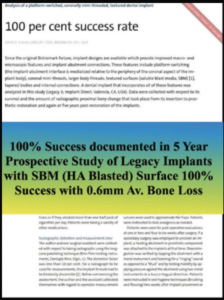
BioHorizons claims that studies show improved clinical results but this has never been proven in any side-by-side controlled clinical studies. The survival rates reported in some case studies using BioHorizons’ Laser-Lok implants are similar to that reported with implants having micro-threads, blasted and even machined necks, as evidenced by the published 10-year survival studies with ZimVie’s Tapered Screw-Vent® (Niznick Gen3) and this 5-year study with Implant Direct’s Legacy® (Niznick GEN4) implants, that demonstrated an average of only 0.6mm of bone loss. Dental professionals placing implants are becoming increasingly concerned about the prevention and treatment of peri-implantitis around osseointegrated implants. The same ability of the Laser-Lok feature to attract soft tissue attachment is a concern with regard to the attachment of a biofilm that can contribute to peri-implantitis. There is a renewed interest in implants with a hybrid surface consisting of a smooth neck and textured body. This was the subject of 2022 articles in the Academy of Osseointegration News by
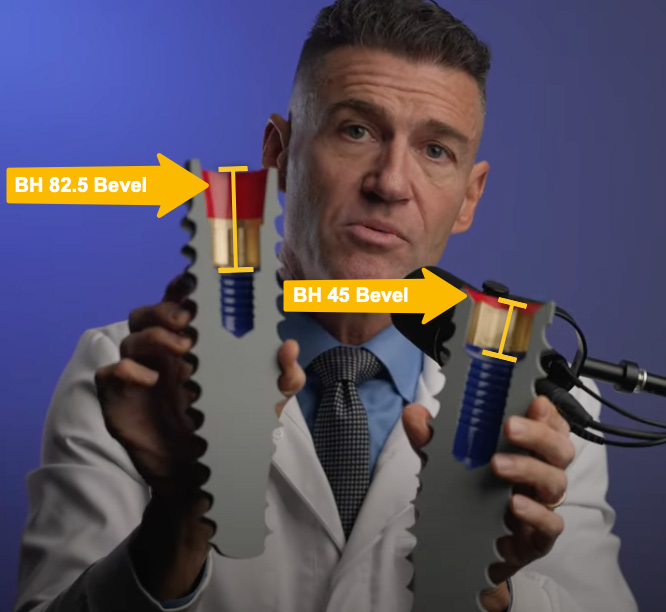
BioHorizons has been producing its implants for the last 2 decades with the 45° conical connection after receiving a license in Dr. Niznick’s 4,960,381 Patent. Dr. Robert Stanley, a dentist with an engineering degree, explains in a video the differences between BioHorizons implants with the 45° conical connection and the new “Tapered Pro Conical” implant with an 82.5° conical connection. As seen in this picture, the steeper conical connection takes up more depth of the implant, which may be the reason why the shortest Tapered Pro Conical implant is 9mm vs 7.5mm for its implants with the 45° conical connection. As Dr. Stanley points out in this excerpt from his video, the walls of the Tapered Pro Conical implant are thinner and therefore more susceptible to fracture.
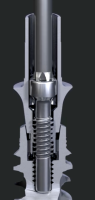
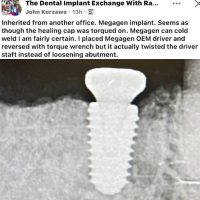
Straumann’s Torqfit connection on its BLX implant, like BH’s Tapered Pro Conical implant, also has a very steep lead-in bevel of 83°. Straumann recognized the risk that steep mating bevels could create a friction fit interface and included threads in the internal shaft of its abutments. This allows a Retreival Screw to bottom out in the shaft and disengage the abutment from the implant as shown in this video. Abutments for BH’s Tapered Pro Conical implants do not provide internal threads or retrieval screws, and therefore could suffer the same fate as this Megagen implant, with its 85° lead-in bevel, having a 1-piece healing collar “cold welded” to the implant.
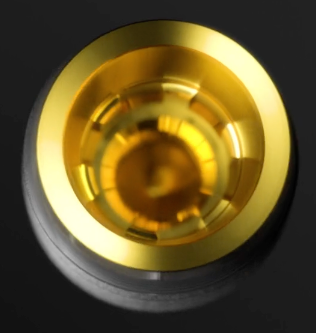
Dr. Stanley shows the difference between the precision required to seat 6 mating hexes compared to how the 3 narrow projections on the Tapered Pro Conical abutment drops into place. Straumann’s BLX implant also has 6 internal grooves but its abutment also have 6 mating projections for greater stability. The increased surface area of the mating hexes in BH’s older implants will assure a more stable connection between the abutment and implant, reducing the chance of screw loosening.