Controversial Issues that Effect the Dental Implant Industry
Shortcomings of NobelActive™ Implant in Contrast to Paragon's TriActive™ Implant
September 24, 2024 | Dr. Gerald Niznick
Share this Post:

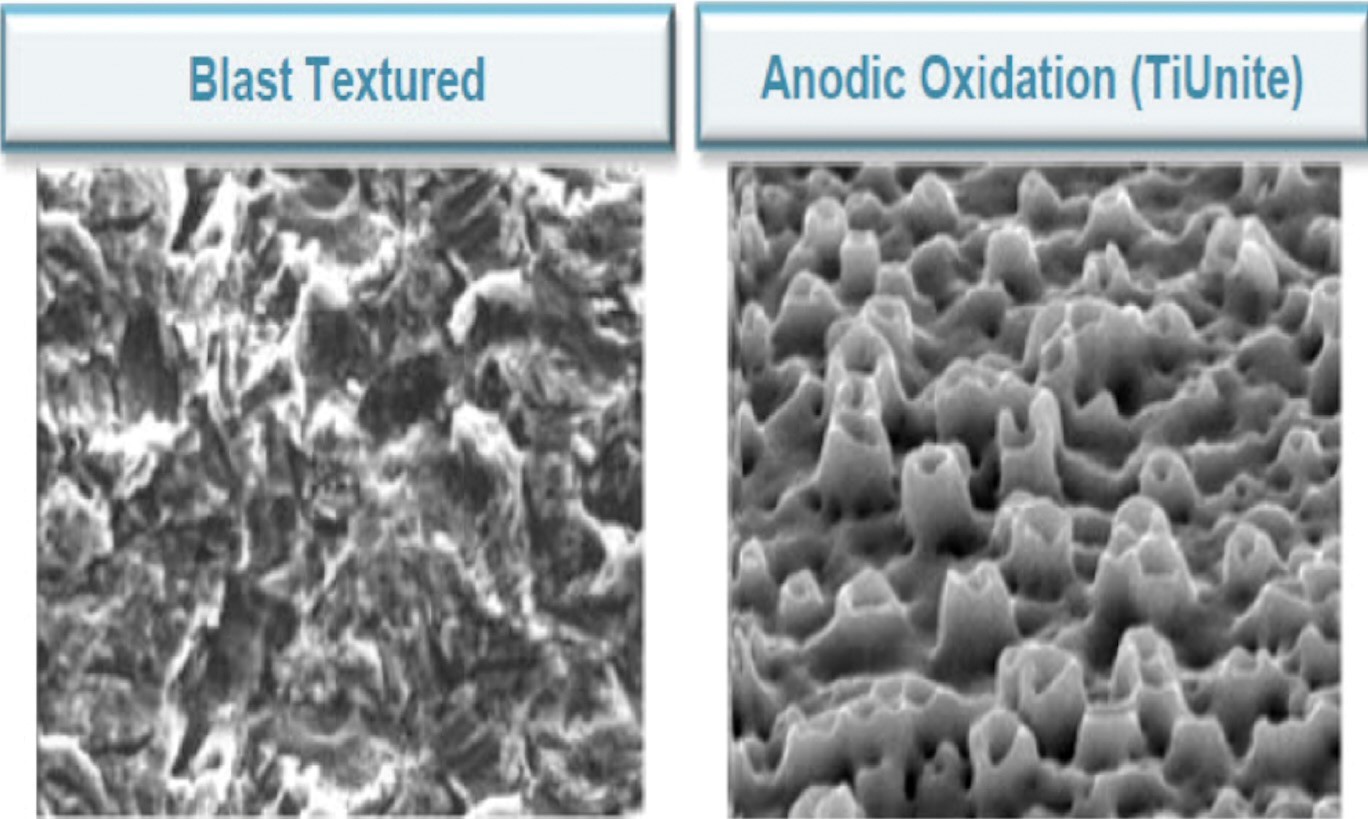
The NobelActive™ implant was introduced in 2008. It has an internal hex connection with a 78° lead-in bevel. It could not be launched in United States until after October 2007, when the internal Conical Connection Patent, Niznick 1990, expired. The Implant was introduced with an anodized, porous surface to the top of the implant, which NobelBiocare® called TiUnite™. In 2020, because of numerous clinical reports of bone loss and soft tissue complications(peri-implantitis) associated with the exposure of the porous TiUnite. NobelBiocare offered the NobelActive, as well as the rest of its implant designs, with a machined, anodized 2mm collar, which they called TiUltra™ surface. This was accompanied with a price increase and as of September 2024, there is a $19 price differential between the original and hybrid surface designs. Having a smooth neck on the implant, called a hybrid design, is well supported by research. Nobel also anodized the surface of its abutments, called it Xeal™, and claimed it enhanced soft tissue attachment, which they called Muco-integration™. These claims are highly questionable as anodizing titanium just changes the refective nature of the surface, not its texture.
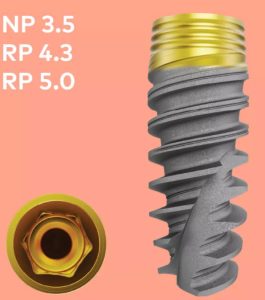
The NobelActive System primarily consists of 3 implant diameters, 3.5mmD, 4.3mmD and 5.0mmD. The 3.5mmD implant has a 3.0mmD platform while the other two have a 3.4mmD platform. NobelBiocare also offers a 3.0mmD implant with FDA restrictions for use only for replacement of laterals and incisors, and a 5.5mmD implant, available in a few shorter sizes with the TiUltra surface. This wider implant is primarily for the posterior. These two additional sizes are of limited value considering that the difference in diameter between the 3.0mmD > 3.5mmD, and the 5.0mmD > 5.5mmD is only 1/2mm in cross-section and 1/4mm on each side. 1/4mm = 0.010” or 10 thousandths of an inch, which is about the thickness of 2 human hairs. Soft bone in the anterior could easily be expanded by that amount when inserting a 3.5mmD implant and that minimal difference will not be significant in placing an implant into a posterior extraction socket or in providing additional support for a restoration in the molar area.

The internal conical connection of the NobelActive has a 78° lead-in bevel as measured from the horizontal, which is 12° as measured from the vertical. This is a variation of the original 45° Conical Connection introduced with the Screw-Vent Implant in 1986. Increasing the angle of the lead-in bevel does not increase stability because, to assure a seal at the opening to the internal shaft, the mating bevel of the abutment is .5° less, as measured from the vertical. In other words, the primary contact between the abutment and the implant, regardless of whether the lead-in bevel is 45° or 78°, is only at the opening of the internal shaft. The steeper bevel has two negative consequences: (1) it thins the walls of the implant, and (2) it deepens the hex within the internal shaft by at least 1mm, limiting the development of very short (6mm) implants. The shortest implant offered by NobelBiocare with the NobelActive implants, other than the widest 5.5mmD implant is 8.5mm.
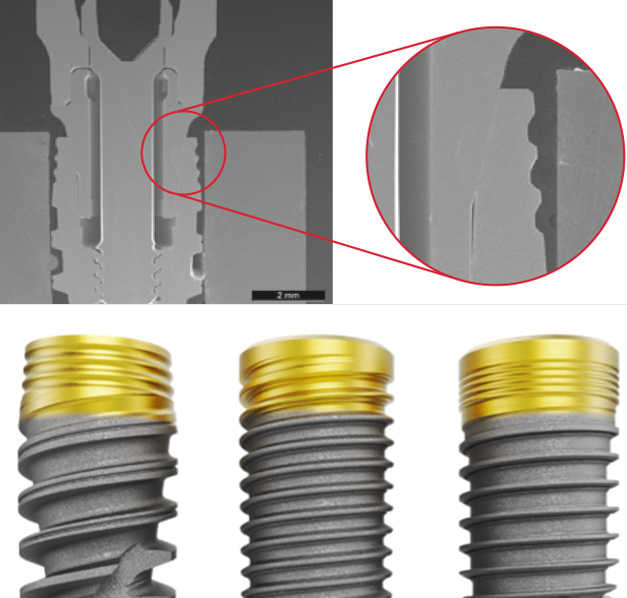
Another shortcoming of the NobelActive™ design is its back-tapered neck on the 4.3mmD, 5.0mmD and 5.5mmD implants. This feature thins the walls of the implant and eliminates contact with crestal cortical bone on insertion, reducing stability and requiring more bone-graft material to seal the gap.
The NobelParallel CC and NobelReplace implants shown here to the right of the NobelActive both have straight necks.
Another shortcoming of the NobelActive™ design is its sharp, self-cutting design of the apex. Rather than having a rounded apex that would act as a stop on full seating in the prepared osteotomy, continued rotation of the implant can cut a deeper socket than the length of the implant, resulting in sub-crestal placement of the implant that can present problems when seating a flared abutment. Another disadvantage of this self-cutting apex is that the implant, on insertion, can deviate in direction from the intended trajectory established by the drilling process.
Another shortcoming of the NobelActive™ design is its short spiral cutting groove that is designed to only function on counterclockwise rotation of the implant. The intent of this feature was that, if the implant does not fully seat in the osteotomy, it would make it easier to unscrew the implant. Because the short cutting groove is not designed to cut the threads in the bone during clockwise insertion, bone taps are often required in dense bone. This adds an additional surgical step while decreasing the initial stability by cutting the bone during insertion rather than compressing it.
NobelActive implants are made from Grade 4 Titanium which is 36% weaker than Ti6Al4V medical grade alloy (Grade 5) used by Paragon as well as many other US
dental implant and orthopedic companies. This strength difference minimizes the risks of fractures on narrow diameter implants. The TiUnite surface, created by Anodic Spark Deposition, will not form on the alloy which is why NobelBiocare’s decision to use a TiUnite™dictates its use of the weaker Grade 4 titanium. Both Grade 4 and Grade 5 Titanium can have the surface color changed by anodizing at a low voltage, but this does not affect the surface texture or chemistry.
TriActive™ has a textured surface created by blasting with HA particles whereas NobelActive has a porous surface created by anodized oxidation.
With all the limitations listed above with the NobelActive™, Paragon Implant™ Company decided to make the TriActive™ System with both surgical and prosthetic compatibility to the NobelActive™. The name was derived from the following design features:
- TriActive™ System would consist of only the 3 most commonly used diameters.
- TriActive™ implants have triple-lead threads of the Tapered Screw-Vent (Niznick 1999) for faster insertion.
- The TriActive™ implants have 3 vertical grooves extending the full length of the implants, 2 of which facilitate self-tapping insertion, eliminating the need for bone taps, and the 3rd cutting groove only functions if and when the implant is turned counterclockwise to remove an implant or enlarge the socket.
Advantages of TriActive™ vs NobelActive™
- Diameters, tapers and lengths match NobelActive™ for surgical compatibility.
- Connections match NobelActive’s NP & RP Platforms for prosthetic compatibility.
- TriActive™ implants are made from Titanium Alloy for 36% greater strength.
- Straight Neck on all 3 diameters increases initial stability and strength while reducing the need for bone graft material to fill the gap from the back taper.
- The horizontal grooves on the 2mm anodized neck necks serve as depth gauge lines with the top line being 1mm, 1.5mm and 2mm from the top.
- The pitch or distance between threads is less on the TriActive™ than the NobelActive™, allowing more threads and greater surface area.
- The depth of the threads on the TriActive™ are shallower than the threads on the NobelActive™, allowing greater compression of soft bone for increased stability.
- The threads on the TriActive™ are triple lead for faster insertion.
- The threads on the TriActive™ are flat-based, reverse buttress threads for better load distribution.
- The TriActive™ has 3 full length grooves with the cutting edges of 2 facing clockwise for efficient self-tapping insertion.
- The TriActive™ has 1 full length groove with the cutting edge facing counterclockwise to enlarge the socket if it does not fully seat.
- The TriActive™ has a rounded apex to minimize the risk of tearing the sinus membrane or over-seating of the implant.
- The US List Price for the TriActive™ will be $125 vs NobelActive at $557 for a $432 Savings (77.5%).